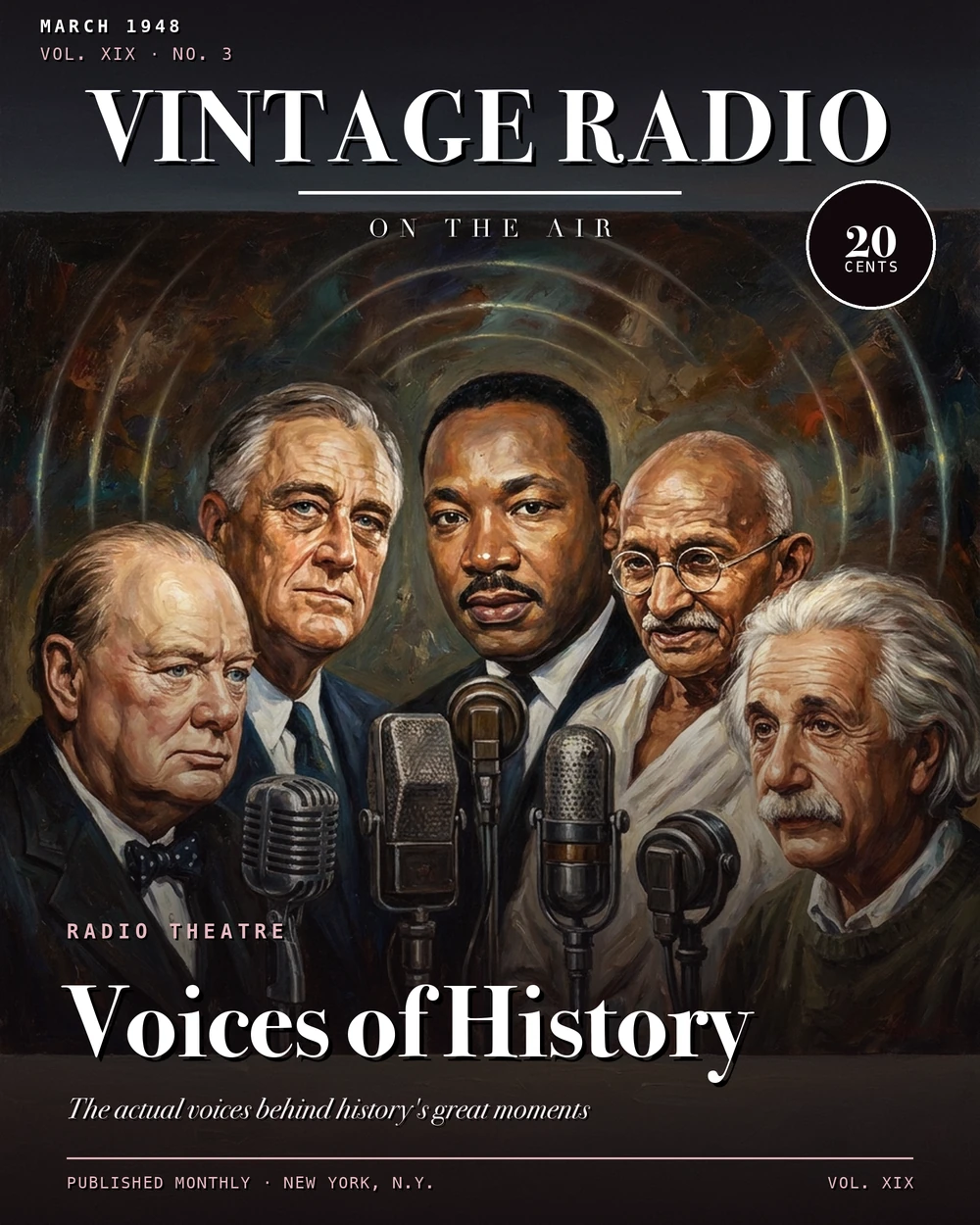
Voices of History
Radio as a Time Machine
Before television news, before the internet, and before the idea of "content preservation" entered anyone's vocabulary, radio was capturing history in real time — and some of those recordings survived. Voices of History is built entirely around that survival. Its 104 episodes don't reconstruct or dramatize landmark moments; they play the actual recordings back. Political speeches, personal testimonies, field dispatches from war zones, the raw sound of grief and triumph and ordinary life at extraordinary moments — the program's premise is simply to let those recordings speak for themselves.
That's a harder format to pull off than it sounds. Curating archival audio into a coherent radio series requires decisions about what counts as significant, whose voices get included, and how much framing listeners need. Voices of History leans toward the inclusive end of that question, mixing the famous and the anonymous — not just political leaders but ordinary citizens who happened to be present, or who had something worth saying, at moments that ended up mattering.
The series is categorized as News, which makes sense in that every episode is grounded in documented fact, dated and placed. But the experience of listening is closer to historical reflection than a news broadcast. The recordings carry their original context with them — the acoustics of a stadium or a field hospital, the cadence of wartime diction, the static of a transatlantic dispatch — and that texture is part of what the series is trading in.
What the Catalog Actually Contains
The range across the 104 episodes is genuinely wide. Some recordings are from events that were major news on the day they aired; others are more personal or ceremonial. A few examples illustrate the spread.
The first Pearl Harbor bulletin from December 7, 1941, is represented — the raw broadcast as it went out before the full picture had formed, when radio stations were interrupting regular programming with fragmentary, urgent reports. That kind of recording captures something a later retrospective cannot: the confusion of the moment before the historical framing had settled. Similarly, the first announcement of Hitler's death, dated May 1, preserves another hinge-point moment — news that was enormous and whose implications were still being processed in real time as the words went out.
The Bergen-Belsen episode takes a different form. BBC reporter Patrick Gordon Walker documented the first Sabbath ceremony openly conducted on German soil after the camp's liberation in April 1945, recording and broadcasting the service. An engineer at New York radio station WEVD captured that dispatch on acetate disc, and it's that recording — a religious service inside a liberated concentration camp, conducted weeks after British forces arrived on April 15 — that gives this episode its material. It's not a speech or a bulletin; it's an act of witness.
Albert Einstein appears in two episodes. One draws on his public statements on Gandhi, in which he called Gandhi "the greatest political genius of our time." The other covers Einstein on the atomic bomb, with source material that includes his December 10, 1945, speech at the Fifth Nobel Anniversary Dinner in New York — "The War is Won, But the Peace is Not" — in which he called for an end to atomic proliferation. Both episodes work because Einstein's recorded voice was preserved and because he was willing to speak plainly on questions that carried enormous weight.
Babe Ruth appears in three episodes, which is a different kind of history but not a lesser one. Ruth's farewell at Yankee Stadium on June 13, 1948 — roughly two months before his death on August 16 of that year — is one of his last major public appearances on record. The series also includes Ruth discussing three personal ambitions and a separate recording on reporters. A 1943 Armed Forces Radio Service interview with Ruth, conducted by sports broadcaster Joe Hasel and later discovered in the archives of Cheshire Academy in Connecticut, illustrates how Ruth's voice was captured across multiple occasions during his later years.
Amelia Earhart appears in two episodes — one on her role as a pilot, one on women in air travel. Earhart recordings survive in institutional archives, including a speech held in the Library of Congress's American Folklife Center collection, which gives the series legitimate archival grounding for both. One further episode, titled "Balaclava Bugle Charge Of The Light Brigade," and another featuring Big Ben tolling in the 20th century, suggest the series extended its scope to sonic documents beyond spoken word — sounds that carry historical associations even without a speaker attached.
The Format and What It Asks of the Listener
What makes this kind of radio work — or not — is almost entirely a question of selection and presentation. The format has no drama to fall back on, no actors, no narrative scaffolding. It relies on the recordings themselves being sufficient. When the recording is from a moment of genuine weight — a liberation ceremony, a death announcement, a farewell from someone who wouldn't survive the year — the format delivers something that produced drama cannot. The listener is hearing the thing itself, or the closest available approximation of it.
Edward R. Murrow and Fred W. Friendly built something adjacent to this with Hear It Now, their CBS program that ran from December 15, 1950, through June 1951. Murrow described the premise as capturing "the actual sound of history in the making," and the Peabody Awards honorable mention the series received in 1950 cited it as "a brilliant application of tape-recording to the purpose of the news summary, by which the listener is privileged to hear the news from the very individuals who made it." That formulation — the listener privileged to hear news from those who made it — describes Voices of History's ambition equally well. Murrow and Friendly had built toward the format through their Columbia Records album I Can Hear It Now 1933–1945, released in 1948, which interwove historical events, speeches, and Murrow's narration to significant critical and commercial effect. The appetite for this kind of archival listening was real.
Voices of History doesn't carry Murrow's name or the prestige of a CBS Friday-night slot, but it operates in the same tradition: the belief that recorded sound, presented with care, is its own form of journalism and history simultaneously.
Preservation and What Survives
The episodes in the Voices of History catalog exist because of a combination of deliberate archiving and circumstance. Transcription discs, acetate recordings, institutional archives, and the efforts of individual engineers and broadcasters account for the survival of most of what's here. The Bergen-Belsen recording is a good example of how precarious that survival could be — it exists because a radio engineer at WEVD made a disc of a BBC dispatch at the right moment. Ruth's Armed Forces Radio interview exists because it ended up in a school archive in Connecticut. Einstein's Nobel dinner speech was preserved as part of the documentary record around the early atomic era.
A commercial record label and series also operated under the "Voices of History" name, releasing LP records featuring excerpts of major speeches from the 1930s through the 1960s — Roosevelt's inaugural address, Churchill's "Finest Hour" speech, FDR's Pearl Harbor address, MacArthur's address to Congress, Kennedy's inaugural address — which confirms that the concept had a life beyond any single broadcast run. The radio series and the record series share a format philosophy, even if their relationship isn't fully documented.
What the 104-episode catalog represents is a particular slice of what survived, curated into a form that holds together as a radio series. The span from a Balaclava bugle charge to Einstein on nuclear weapons to Babe Ruth saying goodbye is genuinely wide — and the thread holding it together isn't a theme or an argument but a commitment to the original recording, and to letting the people who were there do the speaking.